The Mark · The Path
There Are No
Wrong Turns.
How a necklace I stared at for a month became the mark of everything I built, and what a three-thousand-year-old drawing knows about being lost.
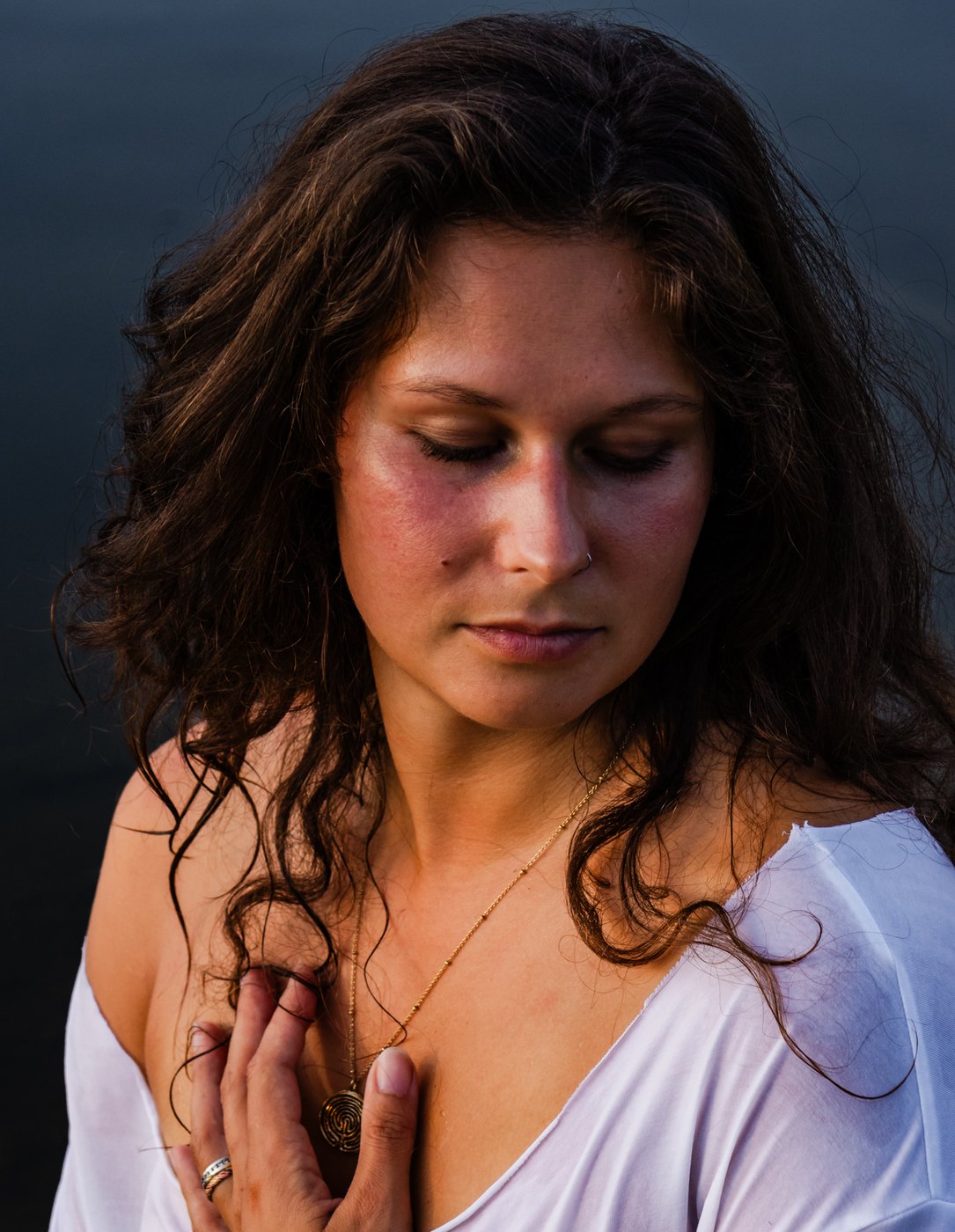
People ask how I got my logo, and they expect a story about a designer. There wasn't one. The honest answer is that it found me, and it took me months to notice.
It was a necklace. A small labyrinth, hanging on a thin chain. I saw it and could not leave it alone. I went back to look at it, left it, went back again. A month of this. Eventually I asked my mother to give it to me for Christmas, and she did.
I am glad it came that way. Something given by someone else's hands carries differently than something you buy yourself on a Tuesday. Though I want to say — there is nothing wrong with giving yourself the gift, either. If a thing keeps calling you for a month, that is information.
I wore it every day. Through the move, through the first winter here, through the months when I was trying to work out what to call this place and what its mark should be. I sketched things. Nothing was right.
And then one morning I looked down, and there it was, lying against my chest where it had been the whole time.
A labyrinth is not a maze.
Most people use the two words as if they mean the same thing. They are opposites.
A maze is built to confuse you. Branching paths, dead ends, wrong choices, the possibility of failing. You can be lost in a maze — that is the point of one.
A labyrinth has a single path. One way in. No branches, no dead ends, no choices to make. You cannot take a wrong turn in a labyrinth, because there are no turns to take. You can only walk, or stop walking.
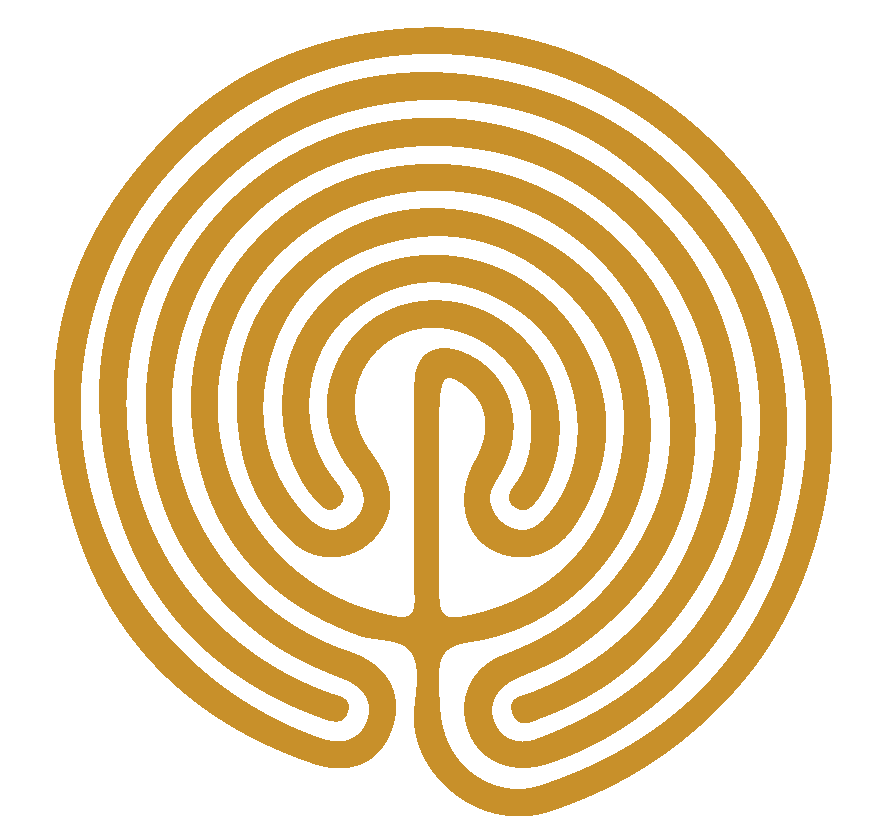
Seven circuits · one path
Look at the drawing for a moment and follow the line with your eye. Here is the part that gets me every time: the path takes you almost to the centre, and then turns you away. It sends you back out to the very edge, past everything you have already walked, when you were certain you were nearly there.
And it is still the only path. You have not gone wrong. You are exactly where the way goes.
What I was trained to look for.
I worked in psychiatry. You are taught, in that world, to find what is wrong — the disorder, the deficit, the thing that broke. It is a useful skill and I do not dismiss it. But it builds a habit of looking at a person as a problem with a cause.
Almost everyone who comes to me arrives with that same habit turned on themselves. They believe they took a wrong turn. Somewhere back there — the job, the marriage, the year they should have left, the thing they should have said — they made the error, and now they are somewhere they were never supposed to be, and the way back is gone.
I do not think that is what happened. I think they are at the part of the path that turns away from the centre. It feels identical to being lost. It is not the same thing.
That is not a comforting thought I made up for a website. It is why I use this mark instead of something prettier.
The oldest one we have.
When I started reading about the shape, I expected Crete. Everyone calls it the Cretan labyrinth, after the coins of Knossos and the myth of the Minotaur in the maze beneath the palace.
The oldest one anyone can date is not Cretan. It is scratched into a clay tablet from the palace at Pylos in mainland Greece, around 1200 BC. Somebody drew it on wet clay — perhaps idly, perhaps not — and then the palace burned to the ground. The fire baked the tablet hard, and the drawing came out of the ruins three thousand years later.
I light a fire here every day of the winter. I think about that more than I should.
And here is the part I find genuinely strange. The same seven-circuit path has been found carved into rock in northern Italy, in Galicia in Spain, in India, and in the American Southwest, by people separated by oceans and thousands of years, who could not possibly have seen each other's work.
There are two explanations. Either it travelled further and earlier than we can trace, or the shape is simply what you get: it grows out of a simple seed — a cross with a dot in each of the four corners — and anyone who starts drawing from that seed arrives at the same path. Both explanations are remarkable. One means we were more connected than we thought. The other means the shape was always waiting to be found.
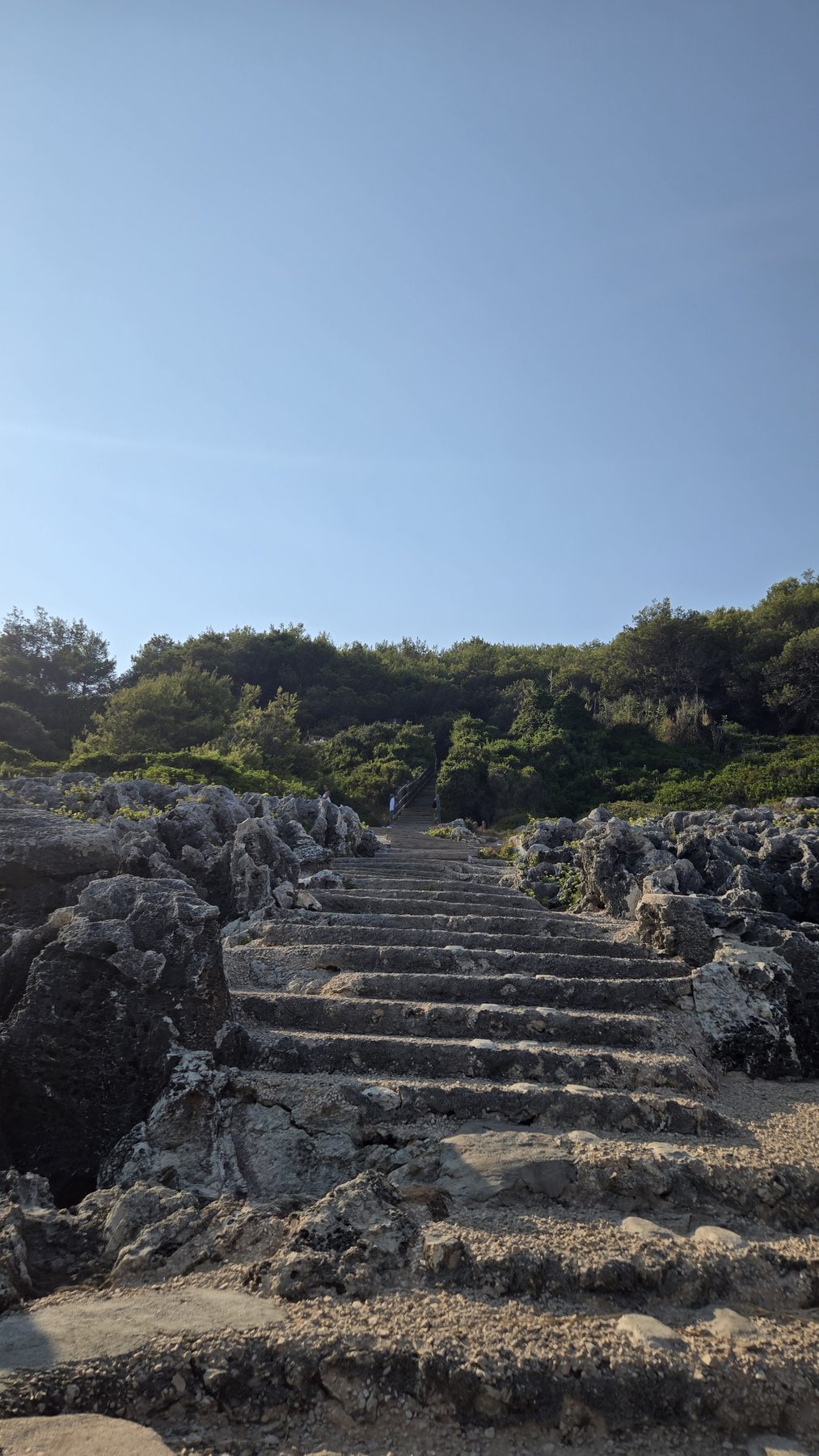
The path back up from the sea, Salento
Il Sentiero means the path.
The name arrived within a few months of the necklace. Neither of them was a decision, exactly. I had no business plan, no brand, no idea what I was building. I had a house by the sea, a lot of years behind me, and a very strong feeling.
People who work in marketing tell me this is not how it is supposed to go. You choose a position, then a name, then a mark. Mine arrived in the wrong order and from the wrong direction, and they fit each other better than anything I could have commissioned.
What it means for the week you might spend here.
I am not going to tell you that you will arrive at the centre in five days. That is not what the shape promises. What it says is smaller and more useful than that.
There is one path. You are on it. The stretch you are walking right now, the one that seems to be taking you further from where you wanted to be, is part of it — not evidence that you failed.
And the only real way to get lost is to stop walking.
That is what I wear around my neck. That is what is on every page of this website, and on the wall, and at the bottom of every letter I write. It was a necklace I could not stop looking at, and it turned out to be the whole thing.
— Nikita